
The Scale of Smartphone Manufacturing
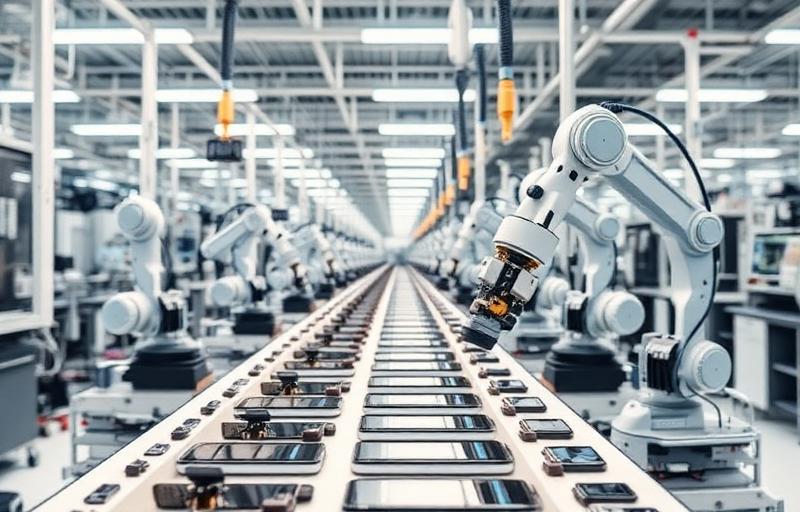
Every second, roughly 44 new smartphones emerge from factory assembly lines around the world. By the time you finish reading this sentence, over 200 devices have been completed — tested, packaged, and readied for shipment. The modern smartphone factory is a marvel of precision engineering: robotic arms place microscopic components onto circuit boards, cameras are calibrated using laser systems, and screens are bonded to chassis in cleanroom environments rivaling pharmaceutical laboratories.
With 3.8 million units produced daily, the global smartphone industry moves at a pace that dwarfs most manufacturing sectors. To put it in perspective: the entire global automobile industry produces roughly 230,000 vehicles per day. Smartphone factories outproduce car factories by a factor of 16.
Where Are These Phones Made?
China remains the undisputed center of global smartphone manufacturing, producing over 70% of all devices. The city of Shenzhen alone — sometimes called the "Silicon Valley of Hardware" — houses thousands of electronics factories within a 100-kilometer radius. Foxconn's flagship plant in Zhengzhou, known as "iPhone City," employs over 200,000 workers and can produce 500,000 iPhones per day during peak season.
India has emerged as the second-largest manufacturer, driven by government incentives under the Production Linked Incentive (PLI) scheme. Samsung's factory in Noida is one of the world's largest, while Foxconn and Pegatron have expanded operations in Tamil Nadu and Karnataka. Vietnam rounds out the top three, with Samsung's massive complexes in Bac Ninh and Thai Nguyen producing over 100 million phones annually.
The Resources Behind Each Device
A single smartphone contains over 30 different chemical elements, including rare earth minerals like neodymium, dysprosium, and praseodymium. Cobalt for batteries is mined predominantly in the Democratic Republic of Congo. Lithium comes from salt flats in Chile, Argentina, and Australia. Tantalum, essential for capacitors, is sourced from Central Africa and Brazil.
At 3.8 million phones per day, the industry consumes staggering quantities of raw materials: an estimated 18,000 tonnes of glass, 7,600 tonnes of aluminum, and 380 tonnes of cobalt every single day. The water footprint is equally massive — manufacturing one smartphone requires approximately 12,760 liters of water when accounting for the entire supply chain, from mining to fabrication.
Production Trends and Market Dynamics
The smartphone market has shifted from explosive growth to strategic maturation. Peak production occurred around 2017–2018 at 1.55 billion units annually. Since then, longer device lifecycles, improved durability, and market saturation in developed economies have modestly reduced annual volumes. In 2026, production sits at approximately 1.4 billion units — still an enormous number, but one that reflects consumers holding onto devices for an average of 3.5 years rather than upgrading annually.
Foldable phones, AI-enhanced cameras, and 5G connectivity continue to drive replacement cycles in premium segments. Meanwhile, sub-$150 devices dominate in Africa and South Asia, where hundreds of millions of first-time smartphone buyers enter the market each year. This dual dynamic — premium innovation in wealthy markets, volume growth in emerging ones — keeps the 3.8 million daily figure remarkably stable.

The E-Waste Challenge
With 3.8 million new phones produced daily, the question of what happens to old devices becomes urgent. The United Nations estimates that the world generates 62 million tonnes of e-waste annually, with smartphones contributing a significant portion. Only about 22% of e-waste is formally collected and recycled. The rest ends up in landfills or is processed informally — often in developing countries, where workers disassemble electronics by hand without adequate protection.
Recycling a smartphone can recover valuable materials: one tonne of circuit boards contains 40–800 times more gold than one tonne of gold ore. Yet collection remains the bottleneck. An estimated 5.3 billion old phones sit unused in drawers and closets worldwide — a "urban mine" worth billions in recoverable materials. Manufacturers like Apple, Samsung, and Fairphone have introduced trade-in programs and modular designs to extend device lifespans and improve recyclability.
Putting 3.8 Million Per Day in Context
If you stacked every smartphone produced in a single day, the tower would reach approximately 33 kilometers high — well into the stratosphere and nearly four times the cruising altitude of a commercial aircraft. Laid screen-to-screen, a day's production would cover 2.5 square kilometers, roughly the area of a large shopping mall complex. The combined weight — around 700 tonnes — equals approximately four fully loaded Boeing 747 freighters.
The smartphone has become the most widely manufactured consumer electronics device in human history. No other product has achieved this combination of complexity, affordability, and universal demand. From factory floor to pocket, each of the 3.8 million devices produced today will connect someone to the global digital economy — enabling communication, education, commerce, and entertainment on a scale previous generations could not have imagined.
Explore more real-time data: Emails sent per day · Google searches per day · App downloads per day